
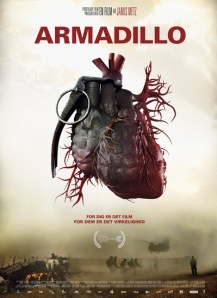
 I have seen a lot of films about war, but nothing quite compares to Armadillo. Most films of the sort seem to have some kind of agenda, and don’t quite show all the sides to what is going on. Armadillo is a documentary, its only agenda is to give you a first hand look at what it is like as a soldier in the Afghanistan war. It does not try to say, this war is wrong, or these people are animals. It simply shows you these men, in this environment, and what it is actually like for them. Director Janus Metz accompanied a group of Danish soldiers to Afghanistan and stayed with them for six months. I am sure he collected a lot of footage, but with editor Per K. Kirkegaard they have made a very interesting 100 minutes of film. It isn’t a biased opinion, it isn’t there to try and get people to sign up to go to war, or for people to run out and protest. It shows what their lives are like there, how often they face dangers and how they feel about it.
The film as I imagine was not an easy one to make, and the fact that the cameras are there filming all sorts of events is extraordinary to think about. Being right there when things happen, and to see the reactions of the soldiers is quite something to witness. Seeing a blast go off, and a soldier being injured and those injuries being taken care of on the spot until they can get some real medical attention is rather eye opening. While watching this, I actually felt as though I was there, experiencing these events along with everyone else. It feels so very real, and shocking, that at times I just couldn’t believe this was actually real. Where the men were based in Armadillo, sees them get more action than other places. In turn the soldiers are always expecting to see action, and when there isn’t much to do they try to find things to fight the boredom away (including watching porno films). It really shows what these men get used to, and how debilitating the boredom must be.

With this film, I think we really get a taste of all the elements that the soldiers experienced during their time there. From the moment they leave and saying good-bye to loves ones, to arriving at Armadillo and getting briefed, to seeing action, getting injured, returning from injury, having nothing to do, trying to find some time to feel normal, seeing action again, hearing about another group getting four casualties, and then returning home and for some deciding to either leave the military or do another tour. The film does give some in-sight as to why some decided to return and others not, each person is different and feels different things, we understand that and it made for compelling viewing. Unlike other documentaries, it doesn’t have sit downs with the men it films, they do not talk to the camera about their experiences, instead we are left to have those experiences with them. I found that to be something unexpected, however with the way this was put together it really worked.
Armadillo I think will remain as one of the most honest and frank looks at the war, letting us inside this experience with those men. I would be interested to hear how soldiers who have been there, see this film and whether it did a good enough job to show us what it is like. It certainly opened up my eyes to a lot of different things, and it is important to really show all sides to war (as it is with situations). This is a film that should be seen, it is a valuable one in terms of what it says and how it is presented. It is complex in its relationships, but simple enough to follow and experience. As much as I want to recommend this, it is not an easy film to get through. War is not something that should be easy to deal with, and this film really gets that message across. You really should brave it, as it is an engaging piece of non-fictional cinema.
Rating:

 The Super Network
You seem to be pushing the film’s objectivity pretty hard but I would kind of argue that any accurate depiction of a war like ours is instantly anti-involvement. I know that what you are essentially saying is that the film never feels the need to push this point any further, and with that I agree, but I’m not quite sure if that’s the same as objectivity.
I mean if you went into the movie wanting to find evidence for your anti-war sentiment you would come out sated, but if you went in looking for pro-war jargon, there really isn’t any there. I guess it’s best summarized by that old adage of ‘Don’t support the war, support the troops,’ and I can support that kind of approach.
Good movie though and a great review; just being pedantic.
LikeLike
I didn’t notice I did that, however this was actually one of the most challenging reviews I have written. The film was unlike anything I had experienced, and it was difficult to put that experience into words.
LikeLike
Well I certainly didn’t mean it as a criticism, I’m not saying that you were doing anything wrong in pushing that part of it because A) It’s a valid point and B) Who the hell am I?
I just didn’t feel that the experience was entirely without position or interest; there aren’t exactly any scenes in there that counteract the many instances of crying, disenfranchised civilians for example.
When a war is as bad as this one you really have to force the positives and so an effortless, accurate portrayal is going to swing a little the other way by default.
Have you seen Restrepo? It’s a similar style of entrenched documentary that I think you’ll dig (pun!) next time you’re looking for a hit of military documentary.
LikeLike
I haven’t seen Restrepo, but it is on the list.
LikeLike