Yep, that time of the year has once again arrived. The Melbourne International Film Festival (or MIFF for short) is back for another year to deliver some of the best and most acclaimed films from all over the world for 18 days. MIFF has always one of Australia’s most beloved film festival, so it’s always exciting time when it comes around every August. As someone who has both covered and attened the festival for this website 10 times previously, it’s definitiely without a doubt one of my favourite film related events of the year. Over 250 films will be playing at the festival in cinemas across Melbourne between August 8th-25th. Some even making their world premires here, including many Australian films. While there are some major high-profile films that are playing at MIFF (two of which being Francis Ford Coppola’s long-awaited passion project MEGALOPOLIS and the body-horror satire THE SUBSTANCE) but like I’ve done in previous years, I’m going to be mostly focusing on films that either don’t have a release date as of yet or they won’t be released until a much later date (whether that will be later this year or sometime in 2025 instead). After going through the program, I’ve narrowed down my list to 40 films that I plan on seeing at MIFF. If I’m honest, I’m very excited to check out the films I’ve picked this year, which includes quite a number of films that have premiered at prestigious films like the Cannes Film Festival, the Sundance Film Festival etc. Now you’re probably wondering, which 40 films are they? Well, without further ado. Here’s my complete rundown of everything that I’ll be seeing at MIFF 2024…
ALL WE IMAGINE AS LIGHT

DIRECTOR: Payal Kapadia
PLOT: The first Indian film to screen in Cannes competition in 30 years is a sensuous tale of two nurses, their romantic entanglements and a mystical trip to the coast. Roommates Prabha and Anu, who work at the same hospital, can’t seem to catch a break. Prabha’s life is thrown into chaos when she receives an unexpected gift from her husband, who lives in Germany and hasn’t spoken to her in over a year. Meanwhile, the younger Anu tries in vain to find somewhere in the bustling city to have a clandestine tryst with her boyfriend, who is Muslim. Frustrated and feeling trapped, they decide to flee their urban environment and travel to a picturesque beach town, where a forest beckons to manifest their dreams and desires. After winning the Cannes L’Œil d’Or for her striking debut feature, the documentary A Night of Knowing Nothing (MIFF 2022), Mumbai-based director Payal Kapadia returns with her highly anticipated fiction follow-up, which was awarded the 2024 Grand Prix at Cannes. All We Imagine as Light brims with an almost painterly attention to contextual detail, depicting moments both intimate and minute, and those with deeper political implications. Kapadia captures the hopes and dilemmas of her characters – and the irrepressible energy of her hometown – with vibrancy and poetic grace, delivering one of the year’s most assured films.
BLUE SUN PALACE

DIRECTOR: Constance Tsang
PLOT: The complexities of the migrant experience are tenderly depicted in this deeply felt debut feature, which arrives fresh from Cannes Critics’ Week. In New York City, recently arrived Chinese workers Amy and Didi are employed at a massage parlour in Flushing, Queens. As they navigate the demands of family back home and the difficulties of their new circumstances, the film sensitively portrays the need for community that defines the process of putting down roots in a foreign land. But when an unexpected act of violence encroaches on the two women’s lives, an unlikely bond is formed. Constance Tsang’s 2021 short film Beau won a Jury Prize at the Directors Guild of America’s Student Film Awards, and her longform debut confirms her as a talent to watch. Here, the Brooklyn-based Chinese-American filmmaker summons a strong sense of place and cultural specificity, aided by a stellar cast headlined by Wu Ke-xi (Nina Wu, MIFF 2019) and Tsai Ming-liang staple Lee Kang-sheng (Vive L’Amour, MIFF 1995 & 2022; The Deserted, MIFF 2018). Blue Sun Palace is a warm, empathetic study of a specific expat community and the universality of the human hunger for connection.
CAUGHT BY THE TIDES

DIRECTOR: Jia Zhang-ke
PLOT: Fresh from Cannes competition, Jia Zhang-ke’s latest portrait of Chinese society in flux is an epic drawn from over two decades of footage. In the earliest days of the 21st century, traditionally minded villagers and restless youths are confronted with an inescapable symbol of China’s commitment to progress: the massive Three Gorges Dam project that will submerge 13 entire cities. Bin (longstanding Jia collaborator Li Zhubin) leaves rural Datong to find greater fortune; soon after, his girlfriend Qiaoqiao (Jia’s wife and muse Zhao Tao) follows. Their paths diverge and intersect across China over the years as Qiaoqiao searches for her lost lover and greater meaning. When she returns to her hometown in an era of COVID, social media and talking robots, she finds it – and Bin – unrecognisable. Mixing documentary and fiction, and revisiting scenes and characters from Unknown Pleasures (MIFF 2002) and Ash Is Purest White (MIFF 2018), MIFF mainstay and Sixth Generation legend Jia remains the master of capturing China’s relentless march towards modernity – and the ‘drifting generation’ lost in its wake. Here, he fashions a free-flowing narrative from over 20 years of video, complete with varied aspect ratios and resolutions. At the centre of it all is Zhao, a magnetic screen presence who digs deeper and deeper into a character that has spanned her husband’s career.
CUCKOO
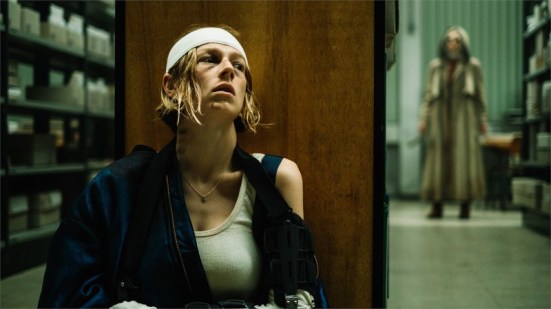
DIRECTOR: Tilman Singer
PLOT: Euphoria’s Hunter Schafer goes head-to-head with Downton Abbey alum Dan Stevens in this frightfully weird horror.Pining for her mother in a throng of bass-strumming and queer angst, teenager Gretchen (Schafer) wishes her mute stepsister Alma (Mila Lieu, Dodger) would just get lost. But when her estranged dad (Marton Csokas, Head South, MIFF 2024) and his new wife (Jessica Henwick, Glass Onion) accept creepy Mr König’s (Stevens) job offer to overhaul the architecture of a suspiciously Overlook-like hotel in the Bavarian Alps, Gretchen quickly regrets her sniping. There’s something stalking the woods in a pale mackintosh, hotel guests can’t keep their dinner down and a perverse experiment is proceeding unchecked – with dire consequences. The eye-popping second feature from German writer/director Tilman Singer, who delivered the demonic possession film Luz, set Berlinale audiences aflutter thanks to its wild and wacky, stylish yet sinister spin on the genre. Proving that Schafer has lead-actor chops with her deft rendition of the Final Girl and that there’s no scenery the magnetically unhinged Stevens won’t gleefully chew, Cuckoo will have you flying off the wall.
A DIFFERENT MAN

DIRECTOR: Aaron Schimberg
PLOT: Sebastian Stan (Captain America: The Winter Soldier) plays a wannabe actor who learns that confidence isn’t skin-deep in this deliciously twisted morality tale. Holed up in his Manhattan flat, aspiring actor Edward (Stan), who lives with neurofibromatosis, is contemplating ending it all – until he finds out his facial tumours can be removed by way of a nightmarish experimental treatment. Now armed with conventional good looks, he assumes a new identity and auditions with gusto … only to learn that his neighbour Ingrid (Renate Reinsve, Armand, MIFF 2024; The Worst Person in the World, MIFF 2021) has written an off-Broadway play about his old life and that he must compete with the infinitely more charismatic Oswald (Adam Pearson, Chained for Life), who also has neurofibromatosis, for centre stage. Channelling David Cronenberg, David Lynch and Ari Kaurismäki in his film’s blend of body horror, dark comedy and surrealism, indie auteur Aaron Schimberg shrewdly takes a scalpel to misplaced ambition and the superficiality of modern society. Stan, who won the Berlinale’s Silver Bear for Best Leading Performance, is endearing as a floundering dreamer who wishes he were somebody else, while Reinsve and Pearson are equally magnetic in this A24-backed title that deviously asks the viewer to take a long, hard look at themselves.
DIDI

DIRECTOR: Sean Wang
PLOT: This double-Sundance-winning semi-autobiographical film surveys a coming of age marked by Myspace and Motorola flip phones during the heady days of the 2000s. It’s the late noughties in Fremont, California. Impressionable young Chris attempts to find his place in the world as he enters the lion’s den of high school – just as social media is exploding in popularity. His big sister Vivian is headed for college, while his mum Chungsing (Twin Peaks luminary Joan Chen, who also starred in The Home Song Stories, MIFF 2007) is a frustrated painter who wants to be seen as more than a caregiver to her ungrateful kids and even less impressed mother-in-law (played by director Sean Wang’s actual grandmother Chang Li Hua). Sharing thematic DNA with Eighth Grade and Mid90s, Wang’s debut dramatic feature – whose title means ‘little brother’ in Mandarin – is an evocative account of growth, the affection and tensions of family, and the immigrant experience, picking up both a Special Jury Award and an Audience Award at Sundance. With these accolades landing in the same year as the Oscar nomination for his short Nai Nai & Wài Pó, Dìdi further cements Wang’s directorial talent.
ELLIS PARK

DIRECTOR: Justin Kurzel
PLOT: Legendary Australian musician Warren Ellis takes us on a guided tour through his world and one very special animal sanctuary. A key member of iconic Australian bands The Dirty Three and Nick Cave and the Bad Seeds as well as a prolific film score composer (The Proposition; Hell or High Water, MIFF 2016), multi-instrumentalist Ellis has cut a brilliant and unorthodox figure in Australian music for over three decades. Far from the international concert halls in which he has plied his craft, however, lies a very different passion project: a wildlife sanctuary in the forests of Sumatra. Co-founded by Ellis and spearheaded by the indomitable Femke den Haas, whose dedicated team of conservationists rescues trafficked and mistreated animals and then devotes years to nursing them back to health, Ellis Park is a beacon of kindness in a world that sometimes has precious little of it to spare.
FLOW

DIRECTOR: Gints Zilbalodis
PLOT: A menagerie adrift on a boat must work together to survive a catastrophic flood in this animated wonder arriving from Cannes Un Certain Regard. In the wake of human extinction and a catastrophic worldwide flood of biblical proportions, a quick-witted black cat makes a life-saving leap onto a drifting ship that’s inhabited by a capybara. They soon pick up a lemur, a stork and a labrador, and encounter a marauding flock of birds. Thrown into an environment in flux, navigating both treacherous floodwaters and dwindling resources, these very different creatures need to find a way to trust one another in order to survive. To create his feature debut Away, Latvian filmmaker Gints Zilbalodis effectively worked as a one-person animation studio: he wrote, directed, animated and composed music for this affecting, visually striking wordless film, which saw him garner acclaim the world over. His follow-up – another striking animated allegory without dialogue – sees Zilbalodis set hand-drawn characters in photorealist landscapes and employ inventive and free-flowing camerawork reminiscent of Terrence Malick. Offering an inspiring corrective to the sickly cute anthropomorphism that pervades mainstream animation and a poignant parable for our climate-catastrophe times, Flow showcases an ascendant master hitting his stride.
GRAND THEFT HAMLET
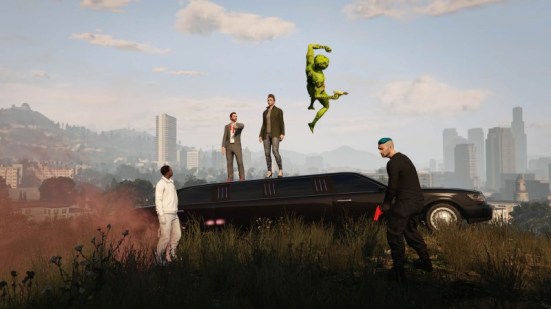
DIRECTOR: Sam Crane & Pinny Grylls
PLOT: The show really must go on as two locked-down actors take Shakespeare to the least likely stage imaginable: the streets of Grand Theft Auto. January 2021: English actor buddies Sam Crane and Mark Oosterveen are stuck in COVID lockdown. With nowhere to work, they hang out together in the multiplayer videogame Grand Theft Auto Online, hooning around in stolen cars and killing everyone onscreen. Sam’s wife Pinny Grylls, a similarly unemployed documentary maker, busies herself filming them. When Mark and Sam stumble across the ‘Vinewood Bowl’, an in-game amphitheatre, what starts as a joke – could someone actually perform Shakespeare there? – swiftly escalates into a playful collision between the simulated thuggery, the violent mayhem of Shakespeare’s Denmark and the real-world camaraderie of theatre dorks. Grylls takes advantage of GTA’s freewheeling camera angles and spectacular locations to shoot completely inside the game, but also creates her own avatar, becoming a key character. Wacky amateur theatrics evoking the world of Christopher Guest ensue as a motley cast recruited from online forums gathers to awkwardly rehearse through headset mics – when they’re not being murdered by other players or pursued by NPC cops. Beyond its inherent hilarity, this winner of SXSW’s Grand Jury Prize for Documentary Feature is a surprisingly poignant story about unbridled creativity even during the worst of times.
GRAND TOUR
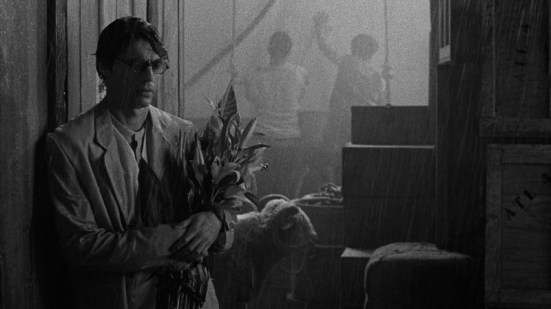
DIRECTOR: Miguel Gomes
PLOT: This Cannes Best Director–winning Asian odyssey spectacularly mashes up time and place, genre and form, to transport audiences somewhere sublime. In 1917, British diplomat Edward is stationed in Burma and travels by train from Rangoon to Mandalay, where Molly, his fiancée of seven years, is finally arriving to join him. But before her steamship can dock, Edward loses his nerve and flees on the next boat to Singapore. This doesn’t deter the exuberant Molly, who promptly sets off after her cowardly bridegroom. He leads Molly on a chase through Bangkok, Saigon, Manila, Osaka, Shanghai, Chongqing, Chengdu and onwards – even through history, transcending storytelling itself. With this virtuosic and frequently anachronistic travelogue, Gomes marries the documentary immediacy of his Maureen Fazendeiro collaboration The Tsugua Diaries (MIFF 2022) and the glowingly stagey, black-and-white colonial pastiche of Tabu (MIFF 2012), using the work of three credited directors of photography to braid the past and present. This stunning cinematic essay on place and memory is much grander in scope than Edward and Molly’s journey; it demands to be experienced moment to moment. As one wise character recommends: “Abandon yourself to the world, and see how generous it is to you.”
HE AIN’T HEAVY
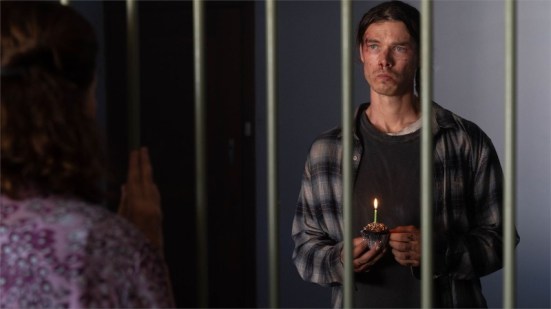
DIRECTOR: David Vincent Smith
PLOT: Animal Kingdom star Leila George rejoins her mother Greta Scacchi (The Player, MIFF 1992; Looking for Alibrandi) in this devastating Australian drama about a family riven by drug addiction. Pushed to the limit by years of trying to safeguard against the mayhem of her meth-addicted brother Max (Sam Corlett, The Dry), Jade (George) snaps one fateful night. Following a car crash that nearly claims the life of their mother Bev (Scacchi), she kidnaps him and retreats to the empty home owned by their grandparents in the desperate hope that this dramatic intervention will force a circuit-breaking rehabilitation. But when Bev arrives unannounced, bearing terrible news, this already-bubbling-over pressure cooker explodes. Expanding on his short film I’m Not Hurting You, the gripping debut feature from Perth-based writer/director David Vincent Smith packs a punch because it’s informed by his own experience of navigating the trauma of addiction within his family. As is often the case when cinema bares the soul of its filmmakers – and as evidenced by He Ain’t Heavy having won four WA Screen Culture Awards, including Innovation in Narrative Feature Film and Outstanding Achievement in Performance (for Corlett) – such potent vulnerability makes for compelling viewing.
HOARD

DIRECTOR: Luna Carmoon
PLOT: The past comes knocking in this four-time Venice-winning feature debut that blends grief, grime, love and childhood trauma. Maria adores her mother, even if society may not look on her favourably. With a penchant for hoarding, Cynthia takes her daughter on bin dives for discarded goods under the guise of adding to what she calls their “catalogue of love”. That’s until a domestic incident triggers a visit from – and their separation by – social services. Fast-forward to Maria’s teenage years and she now lives with a foster family; there, a former foster, the much older Michael, returns. In him, she finds a fellow oddball; for her, he feels fascination, arousal and anguish bubbling to the surface. Stellar performances from newcomer Saura Lightfoot Leon and Stranger Things’ Joseph Quinn elevate the simply strange to the truly engrossing in Hoard. Inspired by Ken Russell and other British filmmakers of the 1960s and 70s, Luna Carmoon’s intimate, at times confronting coming-of-age film scooped four prizes at Venice Critics’ Week. This is an impressive feat for a debutant director – one made all the more so given she originally wrote the film as a 20-page suicide note, whose creation eventually proved healing.
INSIDE
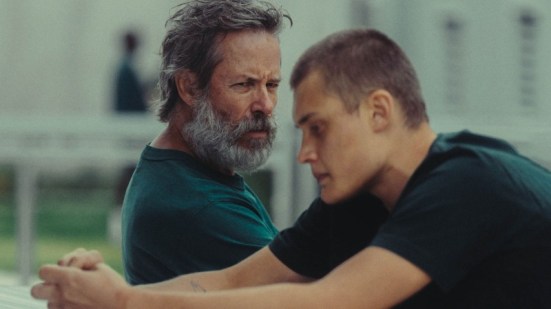
DIRECTOR: Charles Williams
PLOT: Guy Pearce stars in this prison-set portrait of institutionalisation and salvation – the feature debut from Short Film Palme d’Or winner Charles Williams. When Mel Blight (Vincent Miller) is transferred from juvenile detention to a maximum-security adult jail, he’s assigned to share a cell with one of Australia’s most infamous inmates, Mark Shepard (Cosmo Jarvis, Shōgun). Seizing an opportunity, the hardened Warren Murfett (Pearce, The Shrouds, MIFF 2024) recruits Mel to kill Mark, who has a contract on his head. As Warren nears parole and a reunion on the outside with his son Adrian (Toby Wallace, Acute Misfortune, MIFF 2018), the relationship between the three men grows more entangled and intimate. Who can make amends for their crimes? And who is beyond saving? Executive-produced by Thomas M. Wright (The Stranger, MIFF 2022) and supported by the MIFF Premiere Fund, Inside is the impressive first feature from ascendant filmmaker Williams, whose drama All These Creatures (MIFF 2018) won the Short Film Palme d’Or at Cannes. Shot in Melbourne and regional Victoria, the film showcases a trio of powerhouse performances – from Miller in his debut role, to a transformative turn from Jarvis, to Pearce conveying both hope and hopelessness as a prison lifer – and poignantly examines the complex interplay between incarceration, rehabilitation and remorse.
IN VITRO

DIRECTOR: Will Howarth & Tom McKeith
PLOT: A disturbing secret threatens a couple’s relationship in this rural-set sci-fi thriller starring Succession’s Ashley Zukerman. Like many farmers tending to land and livestock around the country, Layla and Jack live an isolated existence. While their son is away at boarding school, Jack experiments with biotechnology to breed cattle, and Layla quietly laments her child’s absence and her strained relationship with her husband. When Jack is injured during a storm-induced blackout – in what he dismisses as an incident with the cattle – Layla begins to probe the true nature of his experiments. As Jack’s controlling behaviour intensifies, an upsetting discovery ruptures the monotony of their rural idyll. Writer/directors Tom McKeith and Will Howarth have teamed up once again following their warmly received 2015 debut feature Beast. Co-written with star Talia Zucker (Lake Mungo, MIFF 2024) – who plays Layla alongside Zukerman’s Jack – their thought-provoking screenplay tackling the dynamics of possession and manipulation was developed after being selected for the Sundance Screenwriters Lab in 2016. Meanwhile, cinematographer Shelley Farthing-Dawe imbues a haunting energy to the plains around Cooma and Goulburn in New South Wales, which serve as the moody backdrop to this tense, outback-set sci-fi thriller.
LA COCINA

DIRECTORS: Alonso Ruizpalacios
PLOT: Rooney Mara stars in this gorgeously shot, righteously angry portrait of kitchen workers stewing in the pressure-cooker conditions of a New York City bistro. At popular Times Square establishment The Grill, Estela meets the many characters who will soon define her working life in this new country, including waitress Julia (Mara); her boyfriend Pedro (Raúl Briones, A Cop Movie, MIFF 2021), a chef; and his rival Max. As the cooks battle it out for culinary supremacy, Julia clashes with Pedro over whether to terminate her pregnancy, while Estela and the other undocumented migrants weigh up their fates in the US. Meanwhile, between the frenzy of orders and errands, the staff discuss romance, family and their memories of home. Based on Arnold Wesker’s play The Kitchen and informed by the director’s own experiences of minimum-wage drudgery, this Berlinale competition standout interrogates the sad realities of the restaurant industry, the exploitation of immigrant workers and the cultural disconnect between North and Latin America. But Alonso Ruizpalacios (Museum, MIFF 2018) also contrasts his film’s kitchen-confidential chaos with moments of quiet humanity, with stately compositions, gliding tracking shots and immaculate black-and-white cinematography further enhancing the palette. Fans of The Bear are sure to have their behind-the-food drama cravings sated.
LEFT WRITE HOOK

DIRECTOR: Shannon Owen
PLOT: For eight survivors of childhood sexual abuse, a groundbreaking program that combines boxing and creative writing turns into a journey of recovery, transformation and friendship. “Feel it, express it, heal it.” For the regulars of Mischa’s Boxing Central, the weekly pilgrimage to the gym for the experimental Left Write Hook program goes beyond simply strengthening the body. Guided by coach and academic Donna Lyon, participants Nikki, Dove, Pixie, Gabrielle, Claire, Julie and Lauren learn not just to box but also to recast the darkest chapters of their pasts into poetry, a powerfully cathartic exercise in reclaiming their life narratives. What begins as an eight-week commitment expands into a relationship of 18 months as the women deepen their bonds and decide to present their work to the wider world – ultimately in hopes of puncturing the shroud of silence and shame, and reassuring others like them that they’re not alone. Supported by the MIFF Premiere Fund, Shannon Owen’s intimate observational documentary invites viewers to sit among the women and listen to their stories, pulling no punches as they let their guards down in the spirit of radical acceptance and creative vulnerability. Affirming the now-established knowledge that trauma resides in both memory and muscle, Left Write Hook is a moving account of wounded individuals overcoming their troubled pasts, as well as of the healing that survivors can derive from solidarity and fearless storytelling.
LIKE MY BROTHER

DIRECTOR: Sal Balharrie & Danielle MacLean
PLOT: Although Rina, Freda, Juliana and Jess hail from the Tiwi Islands – at the opposite end of Australia’s sporting capital, Melbourne – they all dream of playing professional footy in the AFLW. But while dreaming is one thing, achieving it is another. They soon discover that nothing about this pursuit will be easy as they each navigate the barriers of urban modernity faced by many First Nations young people. These include, most significantly, the hardship of leaving loved ones and the strain of distance and homesickness, especially on the isolated and vulnerable. This coming-of-age documentary shot in the Northern Territory and Victoria is the feature debut of Sal Balharrie and Luritja and Warumungu filmmaker Danielle MacLean, who previously directed an entry in the anthology film We Are Still Here (MIFF 2022) and has written for Mystery Road. Confronting the universal themes of family, ambition and sacrifice through the specific lens of sport, Like My Brother is an inspiring film that will open viewers’ eyes not just to the realities of life in the Tiwi Islands but also to the resilience required to find success as an outsider.
LOOK INTO MY EYES

DIRECTOR: Lana Wilson
PLOT: Supporter and sceptic alike will be touched as seven psychics connect their clients with the supernatural – or simply with the dreams and fears buried in their psyches. In New York City, shopfront fortune tellers and spirit mediums trade in their dozens between the Starbucks and bodegas. But what actually happens in their sessions? This film takes viewers past the beaded curtain to meet seven psychics and their clients. You won’t find many crystal balls; rather, you’ll get to know true masters of ceremonies – hosts for the most intimate and interior theatre. Through deft and fluent disquisitions on curiosity, memory, loss and loneliness, they give their clients permission to feel the truths they sense are out there. Lana Wilson’s earlier work – including the Taylor Swift concert film Miss Americana and Pretty Baby: Brooke Shields – has scaled the heights of fame and the image of celebrity. In this rare A24-backed documentary, her unobtrusive but meticulous approach respectfully illuminates a different strand of consummate performance. Like the clairvoyant who offers sight beyond the physical realm, Look Into My Eyes presents insights that transcend the obvious, seeking to empathetically shed light on the profound impulses for compassion, connection and closure.
MAGIC BEACH
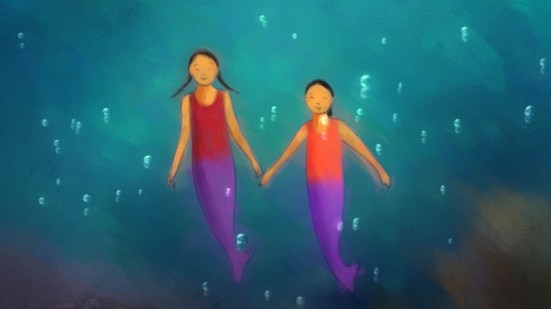
DIRECTOR: Robert Connolly
PLOT: Ten animators bring Alison Lester’s beloved children’s book to the screen, crafting a magical mixture of live action and animation that is destined to become a family favourite. As children hear the enchanting words of Lester’s illustrated classic Magic Beach, they slip into spellbinding worlds of dream and whimsy. Now translated into animated form – covering traditional 2D, claymation, stop-motion and more – it can captivate a whole new generation of youngsters while evoking wonder in the already-familiar. From a host of undersea adventures, tall tales of salty smugglers and escalating sandcastle wars, to sibling-stealing seaweed monsters, psychedelic coral forests and a dog’s dream of shoals of ‘sausage fish’, everyone will find their own fantastical adventure within. First published in 1990, Lester’s rhyming shrine to imaginative play has found its way into the hearts of countless Australians, from wide-eyed kids to the parents who’ve read it at bedtime more times than they can remember. To adapt it for the screen, Robert Connolly (Paper Planes, MIFF 2014; Balibo, MIFF 2009) enlisted 10 of Australia’s most talented animators – Susan Danta, Pierce Davison, Jake Duczynski, Emma Kelly, Simon Rippingale, Marieka Walsh, Eddie White, Lee Whitmore, Kathy Sarpi and Oscar nominee Anthony Lucas – to render a host of incredible, wildly diverse environments. Delivering an incandescent take on a revered Aussie work, the MIFF Premiere Fund–supported Magic Beach is a film of widescreen delight.
MEMOIR OF A SNAIL

DIRECTOR: Adam Elliot
PLOT: Sarah Snook lends her voice alongside Kodi Smit-McPhee, Magda Szubanski, Eric Bana and Jacki Weaver in the stunning second claymation feature from Oscar winner Adam Elliot, which won Annecy’s Cristal Award for Best Feature Film. Her life may be a mess, but Grace Pudel (Snook, Succession; Predestination, MIFF 2014) does derive pleasure from three things: her snail collection, romance novels and her guinea pigs. As children, she and twin brother Gilbert (Smit-McPhee, The Power of the Dog; Slow West) eked out a modest existence with their paraplegic father, a has-been performer gripped by alcoholism and grief after their mother’s death. When he, too, passes away, the siblings are split up by child services: Grace is sent to Canberra, and Gilbert, to Perth. Isolated and depressed, Grace retreats behind a carapace – much like her snails – and fills her emotional void through compulsive hoarding. That is, until she finds a fourth source of joy: a friendship with outrageous octogenarian Pinky (Weaver, Animal Kingdom; Silver Linings Playbook).
THE MOOGAI

DIRECTOR: Jon Bell
PLOT: Jon Bell expands his MIFF 2020 Best Australian Short Film winner into a feature-length horror steeped in the trauma of the Stolen Generations. Ensconced in a comfortable life with her husband Fergus (Meyne Wyatt, We Are Still Here, MIFF 2022) and young daughter Chloe, successful city lawyer Sarah (Shari Sebbens, The Sapphires, MIFF 2012) is initially sceptical of her Indigenous birth mother’s cultural practices and shuns her heritage. After a difficult delivery with her second kid, however, Sarah is swamped with terrifying hallucinations and eerie visions of a storied child-stealing creature lurking in the shadows. Having written for TV series such as Redfern Now, Cleverman and Mystery Road, Bell makes his feature directorial debut with this elaboration of his 2020 short film of the same name, which garnered accolades at MIFF and SXSW (Jury Prize – Midnight Shorts) and a nomination at the AACTA Awards (Best Short Film). Driven by robust and resonant central performances from Sebbens and Wyatt, who reprise their roles from the short, The Moogai is rich with symbolism – the pale monster is depicted as two-faced, with long arms evoking the long arm of the law – and rife with pain. It is an unshakeable cry of rage contained in genre form.
THE MOST PRECIOUS OF CARGOES

DIRECTOR: Michel Hazanavicius
PLOT: Best Director Oscar winner Michel Hazanavicius (The Artist) delivers a stirring Holocaust fable – the first animated film to screen in Cannes competition since 2008. In a snow-blanketed rural village during WWII, a poor Polish woodcutter lives with his wife, who is unable to bear children. Their small, insular world drastically changes when a baby is thrown from a passing train heading for the prison camp at Auschwitz. Seeing it as a gift from God, the woman pledges to raise this child – against the initial resistance of her husband, and in the face of the rising antisemitic fervour of the local villagers. The first animated title to compete for the Palme d’Or since Waltz With Bashir (MIFF 2008) and fresh from screening at Annecy, The Most Precious of Cargoes sees French filmmaker Hazanavicius (Final Cut, MIFF 2022) impressively transition to animated storytelling. Based on a 2019 novel by Jean-Claude Grumberg and narrated by the late French screen legend Jean-Louis Trintignant, this profoundly moving film boasts a striking visual palette reminiscent of graphic novels, while its narrative evokes the ‘once upon a time’ framing and moral storytelling of classic picture books and fairytales.
ODDITY

DIRECTOR: Damian McCarthy
PLOT: This award-winning spine-chiller from Caveat director Damian McCarthy unleashes horror from every corner of a haunted house. Dani is startled by a desperate knocking on the door of the country home she shares with her husband Ted, a doctor at a psychiatric hospital. It’s his ex-patient Olin, who frantically warns Dani that she’s in mortal danger. A year later, Dani’s blind and psychic twin sister Darcy intrudes on Ted and new partner Yana’s domestic bliss, seeking answers for the horrific tragedy that occurred that night. Strangely, she gifts them with a life-size wooden mannequin with a perpetually open mouth, as if screaming from a curse. What are the true intentions of this unwelcome guest, and what will become of the new lovebirds? In an enthralling central performance, Carolyn Bracken (You Are Not My Mother) demonstrates her range by pulling double duty as both the terrorised Dani and the enigmatic Darcy. In turn, Gwilym Lee (The Great) plays the inscrutable Ted with sharply calibrated ambiguity, while McCarthy masterfully builds suspense and toys with convention to turn the ‘blind seer’ trope on its head. It all comes together in a taut, thrilling and at times menacingly humorous work of supernatural horror – one that nabbed Audience Awards at both SXSW and New Orleans’ Overlook Film Festival.
ON BECOMING A GUINEA FOWL
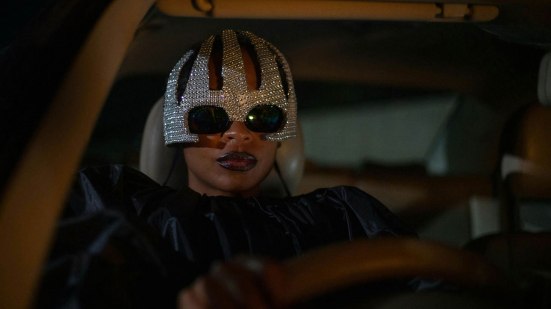
DIRECTOR: Rungano Nyoni
PLOT: With absurdist humour and playfully surrealist imagery, this disarmingly funny Cannes award-winner rages at a middle-class Zambian family’s shameful silence. Shula is driving home from a costume party when she sees a dead body sprawled in the middle of the road. She realises it’s her Uncle Fred: the man who sexually abused her and her cousins Nsansa and Bupe as children. And they weren’t his only victims. However, in their middle-class family’s Bemba culture, nobody speaks ill of the dead. Instead, Shula and her cousins are reluctantly caught up in days of elaborate grieving rites, pressured to eulogise a terrible man and to keep the secret everyone quietly knows. Rungano Nyoni follows her acclaimed directorial debut I Am Not a Witch (MIFF 2017) with another formally adventurous Zambian feminist social critique – this one winning the Best Director prize in Un Certain Regard at Cannes. Here, the dark experimentalism of her first film is focused to devastating effect, building a story around the metaphor of an African bird whose screams warn of a predator. Weaving dreams, apparitions and even children’s television programs into the increasingly overwrought funeral rites, Nyoni makes the viewer ride out the woozy tonal shifts to evoke the upside-down experience of trying to process trauma in silence.
THE ORGANIST

DIRECTOR: Andy Burkitt
PLOT: A man discovers he’s been feeding a cannibal in this deliciously macabre Melbourne-shot indie black comedy. “Eating people is wrong!” At least, that’s what Graeme Sloane believes upon discovering that the organ-procurement business he works for – which ostensibly sources and delivers organs for rich patients in need – is, in fact, a sort of ‘farm’-to-table establishment for a wealthy cannibal. This charismatic Hannibal Lecter type has invited poor Graeme over for dinner, and his surprise at the situation leads to one of those unfortunate meetings with HR where he’s forcibly put on a path of ethically questionable compliance. When he meets his next donor target, though, the pair concoct a plan to make things right. Andy Burkitt’s feature directorial debut, while morbid and murderous, is also charming and unexpectedly quirky, entertaining just as much with its absurd high concept as with its made-in-Melbourne bona fides. While each unsettling plot reveal warps The Organist into an ever darker and more deeply twisted tale, the energy of the game local cast and the unshakeable urge to find out what happens next keeps audiences from looking away.
THE OUTRUN

DIRECTOR: Nora Fingscheidt
PLOT: Saoirse Ronan produces and stars in this moving adaptation about a recovering addict who returns to her childhood home on Scotland’s Orkney Islands. To escape temptation after a stint in rehab, Rona (Ronan) leaves her life in London to reconnect with her remote hometown. She drifts between her religious mother and a father with bipolar disorder, searching for solace and a sense of self in the vicissitudes of circumstance. As flashbacks of her alcohol-fuelled downfall, her doomed relationship with a recent lover (Paapa Essiedu, I May Destroy You) and her time in the ward all puncture her present, she charts the winding path to sobriety using nature as a guide. The Orkney Islands’ ruggedly beautiful landscape, along with the surrounding wildlife, is a focal point of this touching, nonlinear journey of coming back from the brink, adapted from a memoir by journalist (and The Outrun co-writer) Amy Liptrot. German writer/director Nora Fingscheidt (System Crasher, MIFF 2019; Boulevard’s End, MIFF 2014) has admitted that she’s drawn to characters “fighting with their inner demons” and – as embodied by Ronan, whose transcendent star turn has been widely acclaimed – Rona is one such figure whose poise and resolve keep us firmly on her journey.
PEPE

DIRECTOR: Nelson Carlos De los Santas Arias
PLOT: The strange and tragic tale of Pepe, the late ‘cocaine hippo’ once owned by Colombian drug lord Pablo Escobar – as narrated by the ghost of the beast himself. After Escobar’s death in 1993, many of his menagerie of exotic animals were left to wander. In 2009, one such escapee, a hippopotamus nicknamed ‘Pepe’, was gunned down by German hunters; as the first and only hippo to have been killed in the Americas, he fast became a local media sensation. That was the last anyone heard of (or from) Pepe – until now. In this amusingly existential, wondrously off-kilter odyssey, Dominican filmmaker Nelson Carlos de los Santos Arias imagines Pepe having acquired consciousness at the point of death, and lets the late hippo recount his story in his own disembodied words. Variously speaking Spanish, Afrikaans and the Namibian dialect Mbukushu, Pepe – who is startled by his sentience and has little sense of time – describes his unlikely journey from Africa to Latin America, a tale that takes in everything from colonisation to conservatism to the drug war. Pepe is a film quite unlike any you’ll see this year.
THE REMARKABLE LIFE OF IBELIN
DIRECTOR: Benjamin Ree
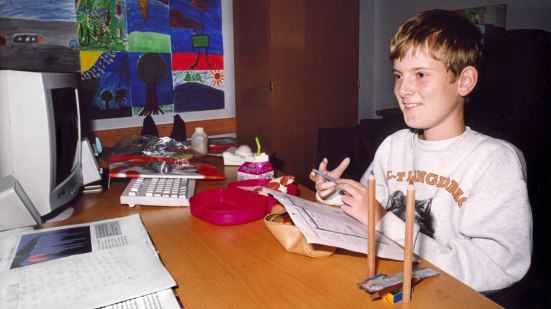
PLOT: When Mats Steen dies at just 25, his parents grieve the loss of their son as much as the full life they believe he was denied. But when they post a death notice on the web, they are inundated with heartfelt condolence messages and stories from people all around the world who had befriended Mats through the online role-playing videogame World of Warcraft. Duchenne muscular dystrophy may have confined Mats’s body, but the degenerative disease couldn’t confine his mind, his soul, his generosity and kindness, or his imagination. Benjamin Ree’s extraordinary film – which features Mats’s own voice, revealed via his extensive blogs – ingeniously challenges the assumption that the young man’s days were defined by isolation, highlighting the connections Mats forged in the gaming community and his friendships that transcended distance and physicality. But it’s from the perspective of his avatar, private investigator Ibelin Redmoore, that his rich alternate existence comes into view, thanks to transcripts and archives from the game world. Winning Sundance’s World Cinema Documentary Directing Award (as well as audience awards at Sundance and Tromsø), Ree seamlessly weaves together home movies, clever narration, interviews with family and friends, and unique WoW-based animation to uncover the truly remarkable life of Ibelin, and of the person behind him, in all its stunning emotional intensity and intellectual curiosity.
RUMOURS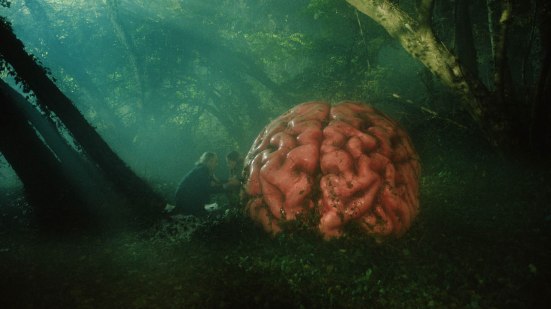
DIRECTORS: Guy Maddin, Evan Johnson & Galen Johnson
PLOT: A gigantic brain in a forest, masturbating bog zombies, Cate Blanchett, Alicia Vikander and Charles Dance all collide in Guy Maddin’s audacious latest film. The G7, led by German chancellor Hilda Ortmann (Blanchett), have descended on a remote retreat to draft a do-nothing communiqué that passes the buck on a looming ecological catastrophe. Only it’s too late for their inaction: it appears the apocalypse is already here. As strange creatures awaken all around them, Hilda must corral her fellow exasperatingly hopeless world leaders – including the Swedish secretary-general of the European Commission (Vikander) and the presidents of the USA (Dance) and France (Denis Ménochet, Beau Is Afraid) – on a wild goose chase into the woods. Maddin (The Forbidden Room, MIFF 2015) once again joins forces with co-director siblings Evan and Galen Johnson (The Green Fog, MIFF 2018), delivering a fever dream of resigned dismay at a global political class that seems as unable as it is unwilling to offer solutions. Blanchett, Vikander and the rest of the cast keep the audience rapt as they bring their A-game – unlike the ineffectual characters they play – to this explosively topical satire. A bittersweet hit at this year’s Cannes, Rumours delivers witty and wildly existential laughs.
THE SEED OF A SACRED FIG
DIRECTOR: Mohammad Rasoulof
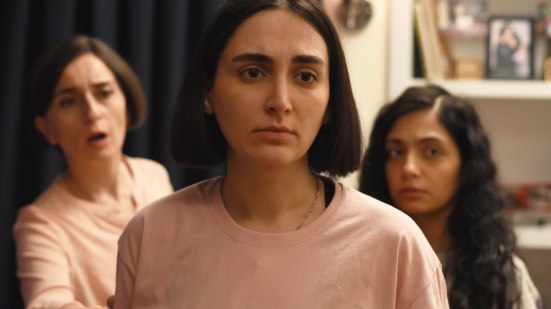
PLOT: Modern and traditional values clash in acclaimed Iranian filmmaker Mohammad Rasoulof’s daring family drama, which won the Prix Spécial and the FIPRESCI Award at Cannes. In Tehran, the exemplary family of an investigating judge are tested by the dramatic events following a young woman’s death in police custody. Civil servant Iman has just been appointed to the Revolutionary Court, where he’s expected to extract confessions, serve death penalties to dissidents, and withhold information from loved ones. As demonstrations against compulsory hijab-wearing rock the city, Iman loses his gun and suspects his wife Najmeh and their two daughters – who’ve been protecting a protester – have stolen it, later subjecting them to interrogations as though they, too, have transgressed the law. Will Najmeh stand up to her husband, and to the state? Responding to his country’s punishing political climate, Rasoulof (There Is No Evil, MIFF 2021; A Man of Integrity, MIFF 2017) returns with a searing drama that captures the growing unrest among a generation deprived of rights. The Iranian director had shot the incendiary film in secret, and – after receiving an eight-year prison sentence earlier this year – fled the country to attend its competition premiere at Cannes. Much like its maker, The Seed of the Sacred Fig is a courageous testament of resistance against tyranny.
SHE LOVED BLOSSOMS MORE
DIRECTOR: Yannis Veslemes
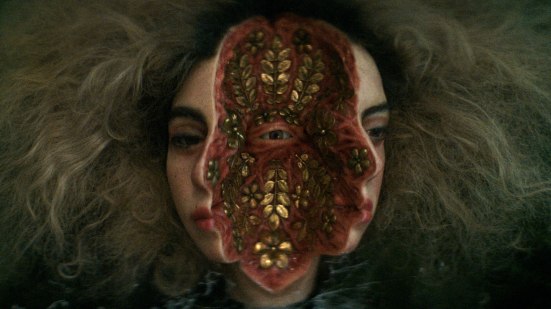
PLOT: Three brothers attempt to lure their mum back from the dead in this bizarre and strangely beautiful nightmare tale. Using a time machine concocted from a wardrobe, a trio of siblings venture to bring their long-gone mother back to the world of the living. As they deal with their delusional father and a girlfriend who plies them with drugs, their wayward experiments catapult them into a time-warped journey of grief and longing that is as visually arresting as it is comedic and disturbing. Premiering at Tribeca, Yannis Veslemes’s outlandish and otherworldly genre trip is delivered as a grainy-textured dreamscape. After the award-winning feature Norway and a series of short films, including a grotesque twist on Greek folklore in the fright-filled anthology Field Guide to Evil (MIFF 2018), the writer/director has dubbed his second feature “a ballad for the defeated, a comedy for the accursed, a moral tale for us all and our beloved families”. With Dominique Pinon (Delicatessen; Alien: Resurrection) injecting a sinister side to the paternal and Panos Papadopoulos, Julio Giorgos Katsis and Aris Balis portraying the desperation of sons left behind, She Loved Blossoms More potently asks: how far would you go for the ones you hold dear?
THE SHROUDS
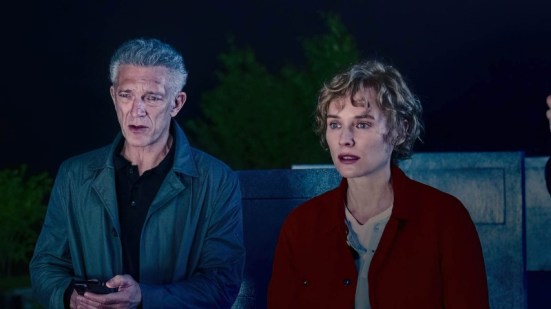
DIRECTOR: David Cronenberg
PLOT: Drawing on his response to his wife’s death, David Cronenberg fashions a deeply personal meditation on loss, longing and grief, filtered through a necro-techno body-horror lens. In desperate mourning for his dead wife, tech magnate Karsh invents a shroud that lets people live-stream, in 8K resolution, their deceased loved ones’ decaying remains. Keeping watch over his decomposing beloved from the cemetery-adjacent restaurant – and date spot! – that he owns, Karsh starts noticing strange growths on her bones. Soon after, her grave and several others are desecrated, and he’s embroiled in an expanding mystery/conspiracy that may or may not involve Chinese spies, eco-terrorism and medical malpractice. As Karsh, Vincent Cassel is a dead-ringer proxy for Cronenberg, underscoring the film’s autobiographical nature – as far as that is possible in an elegiac dystopian biotech-thriller. Diane Kruger gives three full-throttle performances: as Karsh’s dead wife, as her alive twin sister and as an AI assistant that might be messing with Karsh’s mind. Guy Pearce (who also appears in Inside, MIFF 2024) joins the cast as Karsh’s paranoid hacker ex-brother-in-law, hamming it up with aplomb. With costumes designed by Yves Saint Laurent – also producing here – The Shrouds looks suitably sharp and is sure to satisfy Cronenberg completists and cinephiles alike.
SING SING
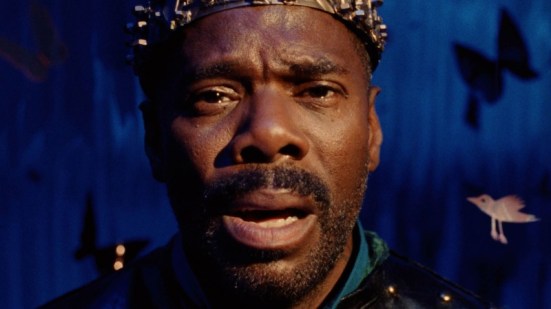
DIRECTOR: Greg Kwedar
PLOT: In this SXSW Festival Favorite award-winner, a theatre group finds hope and meaning through self-expression within the confines of a maximum-security prison. To pass the days while locked up, Divine G spearheads the Rehabilitation Through the Arts (RTA) program, staging Shakespeare productions with other incarcerated men and their director, Brent Buell. When inmate Divine Eye joins the group, their artistic harmony is at first tested by his inability to fully embrace vulnerability. But Divine Eye’s suggestion to turn to comedy sparks ideas and enthusiasm from fellow members, and slowly, the two Divines form a friendship that is as much of a life raft as the program that brought them together. Inspired by a real-life rehabilitation initiative at Sing Sing Correctional Facility in New York, Greg Kwedar’s second feature is anchored on a stellar performance from Oscar-nominated actor Colman Domingo as Divine G. He’s joined by a cast of non-professionals who themselves found solace in the program, including the commanding Clarence “Divine Eye” Maclin. An eight-year labour of love, the project saw Kwedar and co-writer Clint Bentley undertake research by volunteering as teachers for RTA sessions. The resulting film’s power lies not just in its authenticity but in its warmth: a compassionate eye for depicting real experiences, empathetic performances and a 16mm glow that subverts the clinical renditions of life behind bars so regularly seen onscreen.
SUSPENDED TIME

DIRECTOR: Olivier Assayas
PLOT: Personal Shopper (MIFF 2016) director Olivier Assayas proves it is possible to make a beautiful lockdown-set film in this bittersweet, intimate comedy.How many of us have had the chance to wrestle with how the disconnection of COVID has impacted our lives? Assayas, who holed up in his family’s rambling country estate with his brother and their partners, has. In this wittily metatextual musing on the fear of the great unknown of that period, he asks Vincent Macaigne to depict an analogue of himself named Paul, who claims to have directed Irma Vep (MIFF 1997) but who is not the same character that Macaigne played in the show of the same name (MIFF 2014), itself a mischievous update of Assayas’s original film. Meanwhile, highly strung Paul’s interactions with his easygoing brother Etienne exhibit their humorously differing responses to the pandemic. You’ll chuckle at the obsessive-compulsive worries, the petty frustrations and the strained familial relations in this Golden Bear–nominated fancy that namechecks everyone from painters Pierre-Auguste Renoir and David Hockney to the late, great Stranglers keyboardist Dave Greenfield. But the whole in this inventivework of autofiction reaches for something grander: Suspended Time is a thought-provoking contemplation on how the past became very present in isolation.
TIMESTALKER
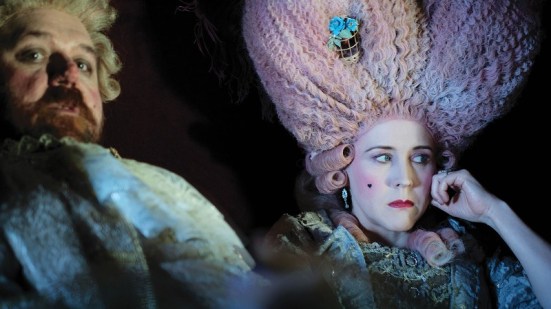
DIRECTOR: Alice Lowe
PLOT: In cult UK comedy treasure Alice Lowe’s second feature, a woman’s misguided fatal attraction to the same pretty bad-boy has lasted six centuries … so far. Agnes is wildly in love with Alex. She won’t listen to her sensible advisor Scipio, hasn’t even noticed that her best friend Meg is equally in love with her, and doesn’t clock that the thuggish George wants her for himself. Agnes simply must have the brooding, edgy outsider, even at the cost of her own life. And, indeed, that’s the violent price Agnes pays – in 1688, 1793, 1847, 1940, 1980 and 2117. Will a prison of passion entrap all these poor souls forever? After co-writing and starring in Ben Wheatley’s Sightseers (MIFF 2012), Lowe annihilated cosy stereotypes of expectant motherhood in her gory 2016 longform debut Prevenge. Now, she’s back to murder amour fou with raucous humour – and an eager ensemble cast including Hot Fuzz’s Nick Frost, Sex Education’s Tanya Reynolds, Interview With the Vampire’s Jacob Anderson and period-drama darling Aneurin Barnard as eternal f**kboy Alex. Timestalker dismantles the glamour of romantic obsession, revealing it as grimy, exploitative and tedious. Desire could be revolutionary and liberating – if only humans didn’t continually pine for undeserving fools!
A TRAVELER’S NEEDS
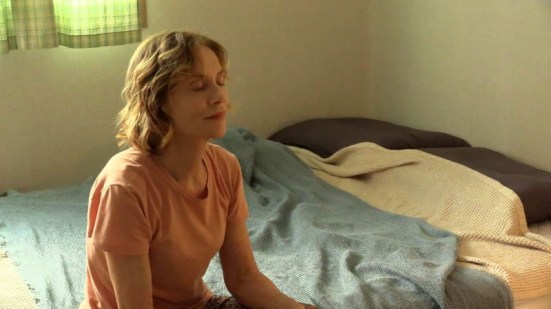
DIRECTOR: Hong Sang-soo
PLOT: MIFF favourite Hong Sang-soo reunites with Isabelle Huppert in this mysteriously tricksy comedy that won the Berlinale’s Silver Bear Grand Jury Prize. Wide-eyed Iris (Huppert) is an expat adrift in Seoul. Eking out a strangely dislocated life mooching in the spare bedroom of a younger man, much to his mother’s ruffled chagrin, Iris teaches French to the locals using unusual methods that hint at deeper meanings. When she’s not working, she carves out time for little indulgences like long walks, lying around and sinking too much rice wine. Few actors are as prolific or prodigiously accomplished as French screen icon Huppert – a skill set she shares with South Korean auteur Hong. A match made in cinematic heaven, they join forces for the third time in the director’s wistfully poetic 31st feature, following In Another Country (MIFF 2012) and Claire’s Camera (MIFF 2017). Surrender to this hypnotic film and you’ll be lulled by its elliptical patterns, artfully drawing concentric circles around its characters and their daily preoccupations. Within A Traveler’s Needs are untold riches ready to be mined as Hong and Huppert dance together once more.
AN UNFINISHED FILM
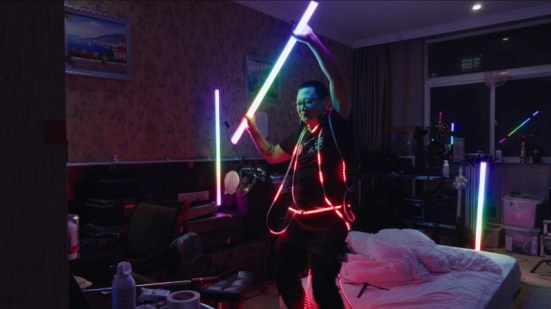
DIRECTOR: Lou Ye
PLOT: When an unfinished film, reborn, is stuck in stasis again, its creators meditate on how their lives have been interrupted and transformed by the pandemic. Chinese auteur Lou Ye tackles the seismic disruption brought by COVID through an exhilarating blend of drama and documentary. In An Unfinished Film, a fictional crew stumbles upon 10-year-old footage of a (real) aborted queer film and sets about reuniting the cast to complete it with a new act. But this is early 2020, and fate has other ideas – the unexpected comes crashing down on Wuhan, the film is halted again and the project eventually morphs into something else entirely. Summer Palace (MIFF 2006), Ye’s devastating romance centred on the Tiananmen Square massacre, competed for the Palme d’Or in 2006. He returned to the Croisette in 2024 with this fascinating hybrid work that ingeniously repurposes old footage from his own filmography, which he splices together with smartphone footage and performed sequences. This time around, his Cannes entry garnered a nomination for the L’Œil d’Or, in recognition of his clear-eyed efforts to make sense of the madness.
US AND THE NIGHT
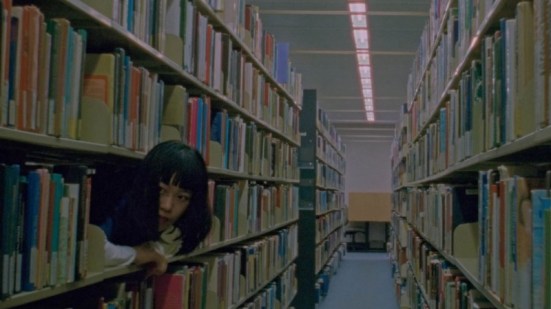
DIRECTOR: Audrey Lam
PLOT: Ten years in the making and shot on transcendent 16mm, this is an unconventional love story for every book-loving introvert. Umi and Xiao work in their university’s library. Their paths cross night after night through the stacks of books – the perfect setting for this film’s own tale of curiosity and adventure. Interacting entirely within the one location, these two characters share wordplay, tour the globe and make music. But where will all of this take them, and why is it so hard to say the things that the books do so easily? Much like the novels and fictions that occupy every frame of Us and the Night, which premiered at New York’s experimental documentary and avant-garde film festival Prismatic Ground, director Audrey Lam plays with language, soundscapes and imagery. As its protagonists explore and discover the hidden worlds of the library, Lam finds rhythm and poetry in the fluorescent lights, the surprising architectural patterns of the building and the shelves lined with accounts of humanity’s history. Expanding on the mystique of her acclaimed short films Faraways (MIFF 2013), Magic Miles (MIFF 2014) and A River Twice (MIFF 2017), this is a beguiling debut feature that is an entirely unique take on what an Australian film can be.
VIET AND NAM
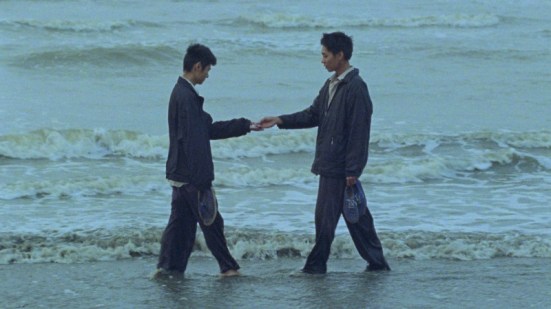
DIRECTOR: Trương Minh Quý
PLOT: Two coal miners in love face their country’s buried trauma and reckon with their risky futures in this hypnotic Vietnamese queer romance. Vietnam, September 2001: news breaks of planes hitting skyscrapers in New York. Meanwhile, in a spangled bower carved deep into the earth, young coal miners Viet and Nam are making love. They can’t stand their dangerous work much longer, but Viet frets that Nam’s plan to emigrate to Europe with the help of a people smuggler is even riskier. Before he leaves, Nam asks Viet to help him find the bones of his father, a soldier who died in the 1970s war. Together with Nam’s hopeful mother and his dad’s old army comrade, they travel through forests towards the Cambodian border, guided by dreams and memories. Premiering to rave reviews in Un Certain Regard at Cannes, Minh Quý Trương’s third film was banned in his home country – not for its queer themes, but because the Vietnamese government perceived its view of national history as “gloomy” and “negative”. But it’s a powerfully sensual film whose focus on the contrasting textures of its protagonists’ homeland is gorgeously rendered in 16mm film. Meditative, even hallucinatory, Viet and Nam resonates on an unsettling, subterranean level and invites comparisons to Apichatpong Weerasethakul.
WAKE UP
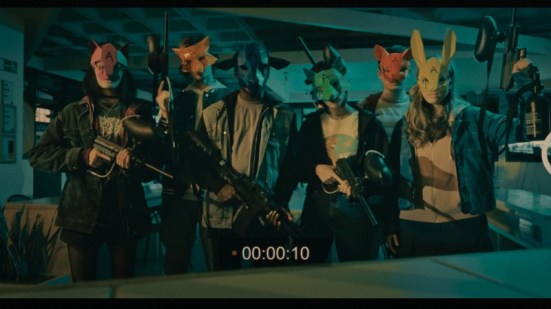
DIRECTOR: François Simard, Anouk Whissell & Yoann-Karl Whissell
PLOT: In this gleefully deranged slasher, six Gen Z activists get more than they bargained for when they break into a furniture store and face a disgruntled – and bloodthirsty – security guard. It was meant to be an emphatic if non-violent act: a group of Gen Z environmental activists have hidden out in an IKEA-esque superstore, waiting until closing time so that they can deface the property to protest the chain’s deforestation practices. Everything is going according to plan until they draw the attention of a pair of nightwatchmen – one drunk, the other deeply, psychologically disturbed and in the mood to terrorise the unsuspecting teens. Slasher fans will be delighted by the latest from gonzo genre stylists François Simard, Anouk Whissell and Yoann-Karl Whissell (Turbo Kid, MIFF 2015) – the Canadian filmmaking team collectively known as RKSS (‘Roadkill Superstars’) – who gleefully revel in horror’s most pulse-racing thrills and kills. With gruesome nods to 80s cult gems like Chopping Mall, this neon-tinted riff on the 1932 survival classic The Most Dangerous Game crackles with unhinged energy and inspired mayhem.
Well, there you have it. These are the 38 films I’ll be seeing at MIFF 2024. Keep a look for my audio review podcasts for all these films over the course of the festival and also follow me at www.twitter.com/BedeJermyn for my daily random thoughts/first reactions to them as well.
Article written by Bede Jermyn
 The Super Network